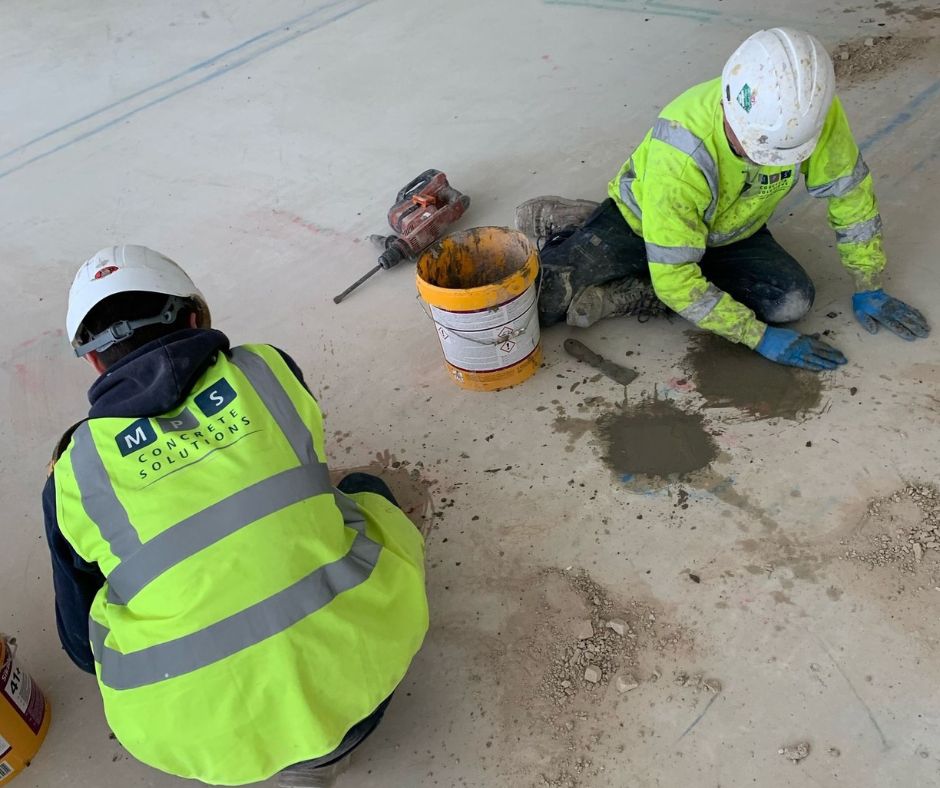
RESIN INJECTION & CONCRETE CRACK REPAIR IN MANCHESTER
Free site survey, a written diagnosis and a fixed, itemised quotation — for commercial properties in Manchester and Greater Manchester
Manchester sites come to us with structural cracks in concrete walls and floors that have started to fail. The survey establishes why before anything is specified, and the written diagnosis goes to you with photographs.
How the Work Is Carried Out
We work across Greater Manchester for warehouses, distribution centres, food production facilities and commercial properties. Each job is assessed on site — cover and carbonation depth where reinforcement is involved, water path tracing where it is leaking — and crack injection resins is specified where it is the right answer rather than by default. Free survey, written specification.
Areas We Cover
And across Greater Manchester
Why Choose MPS?
Resin Injection & Crack Sealing Techniques
We use advanced crack injection resins and proven sealing methods to permanently repair structural cracks in concrete walls, floors, and foundations.
Low-Viscosity Epoxy Injection
For static structural cracks, we inject ultra-low viscosity epoxy deep into hairline fractures, creating a permanent structural bond stronger than the original concrete. Ideal for basement walls and structural elements.
Polyurethane Crack Injection
For active water leaks and moving cracks, we use expanding polyurethane resins that seal and flex with structural movement, stopping water ingress immediately in wet conditions.
Surface Crack Routing
Mechanical cutting and preparation of crack edges to create clean channels for resin injection, ensuring maximum penetration and long-term structural bonding.
Injection Port Installation
Precision placement of injection ports along crack lines, allowing controlled resin flow from the deepest point upwards, ensuring complete crack filling and structural integrity.
Flexible Sealant Systems
Application of movement-tolerant polyurethane and polysulphide sealants for expansion joints and dynamic cracks, maintaining waterproof seals while accommodating thermal movement.
Passive Resin Curtains
Installation of passive hydrophilic resin curtains that expand on contact with water, creating permanent waterproof barriers in damp basement walls and retaining structures.
Crack Injection & Sealing Process
Crack Assessment
We inspect cracks to determine type (structural/non-structural), movement (static/active), water presence, and depth. This determines whether epoxy or polyurethane injection is required.
Preparation & Porting
Cracks are routed, cleaned, and injection ports installed at intervals along the crack line. Surfaces are dried (for epoxy) or dampened (for polyurethane) as required.
Resin Injection
Low-viscosity epoxy or expanding polyurethane is pressure-injected through ports, starting from the lowest point. Resin flows through the entire crack until fully saturated.
Curing & Finishing
After curing (2-24 hours depending on resin type), injection ports are removed, surfaces are ground flush, and optional protective coatings applied for a seamless finish.
Frequently Asked Questions
How much does crack injection cost?
Crack injection costs vary based on crack length, depth, accessibility, and resin type required (epoxy or polyurethane). Typical residential basement crack repairs range from £400-£1,200, while commercial structural crack repairs vary based on scale. Contact us for a detailed quote.
What's the difference between epoxy and polyurethane injection?
Epoxy injection creates a rigid structural bond for static cracks in dry conditions, restoring full concrete strength. Polyurethane injection is flexible, expands in water, and works in wet conditions for active leaks and moving cracks. We select the appropriate resin based on your specific crack conditions.
How long does crack injection resin take to cure?
Low-viscosity epoxy resins typically cure within 24-48 hours. Polyurethane resins cure faster (2-6 hours) and react on contact with water. Full structural strength is achieved within 7 days for most crack injection systems.
Can you inject cracks that are actively leaking?
Yes, we use hydrophobic polyurethane resins specifically designed for wet conditions. These resins react with water, expanding to create a permanent waterproof seal even during active leaks. Epoxy injection requires dry conditions.
Is crack injection a permanent repair?
When properly specified and installed, crack injection provides a permanent structural repair. Epoxy-injected cracks are often stronger than the original concrete. The key is correctly diagnosing crack movement and selecting the appropriate resin system (rigid epoxy for static cracks, flexible polyurethane for moving cracks).
Concrete in Manchester: Ground, Water and Exposure
Manchester is on glacial till (boulder clay) over Triassic sandstone, with alluvium along the Irwell, Medlock and the Ship Canal. The city's rainfall is well above the national average, so concrete here spends more of the year saturated than concrete in the south.
A wet climate slows carbonation but keeps concrete damp enough for corrosion to run once it starts, and saturated decks are exposed to freeze-thaw (XF) every winter. XD de-icing chlorides on car parks and ramps are the usual trigger for spalling on Manchester decks.
For crack injection it decides the resin. A crack carrying water from a high water table needs a water-reactive polyurethane that will cure in the wet; a dry, dormant crack in a frame that has stopped moving can take a rigid epoxy; and a crack caused by ground movement needs an engineer to say whether it has finished moving before anything is injected into it.
Exposure classes are those in BS 8500-1 and BS EN 206 (XC carbonation, XD de-icing chlorides, XS marine chlorides, XF freeze-thaw); ground descriptions follow British Geological Survey mapping. The survey confirms which applies to your structure.
Standards, Credentials & Documented Work
What you can check before appointing us.
Standards that govern this work
- BS EN 1504-5 — concrete injection products for force-transmitting, ductile and swelling crack filling
- BS 8102:2022 — protection of below-ground structures against water ingress, where the crack is in a basement or retaining wall
Who does the work
MPS Concrete Solutions was founded in 2013 and works from Gamlingay, Cambridgeshire (SG19 3JW). Our operatives hold NVQs in resin and grout injection, CSCS, SSSTS and SMSTS cards, and PASMA and MEWP (3a/3b) training, and are confined-space trained.
- Constructionline Gold member; SSIP accredited
- UKAS-accredited certification to ISO 9001, ISO 14001 and ISO 45001
- Concrete Repair Association (CRA) member
- Sika-specified applicator
How we get to Manchester
From our yard at Gamlingay in South Cambridgeshire, Manchester is three to four and a half hours. Planned as continuous multi-day visits rather than day returns, with plant and materials delivered to site.
We say this plainly because it shows up in the price. Mobilisation, access plant and preparation equipment are largely fixed costs, so a single small repair a long way from base carries a much higher rate per square metre than the same work next door to us, or the same work bundled with other defects on one visit. If you have more than one problem on the site, it is worth having them all surveyed at once.
Reviewed by Jerry Blears, Director (LinkedIn), MPS Concrete Solutions. Last reviewed October 2026.
Related crack sealing projects
Canary Wharf, London Hydrophilic resin injection to stop active water ingress at the abutments of a bascule bridge beside the Jubilee Line exclusion zone. Center Parcs Sherwood Forest, Nottinghamshire Leak repair and concrete remediation to the wave-pool balance tanks, completed in full PPE under pandemic restrictions.Our Other Services Across Greater Manchester
Most sites need more than one of these, and it is usually cheaper to have them surveyed together than to mobilise twice.
Industrial Concrete Repairs
Fix cracks, spalling & structural damage
Resin Injection & Crack Sealing
Stop water ingress & seal cracks
Penetration Sealing
Seal pipe & cable penetrations
Cavity Drain Installation
Control basement moisture
External Waterproofing
Protect below-ground structures
Membrane Installation
Waterproof barriers for all surfaces
Send Us Photographs and We'll Tell You What It Is
If it needs a site visit, the survey is free. You get the findings, the cause, and an itemised quotation in writing — the documentation your engineer, insurer or managing agent needs to authorise the works.